Showing posts with label ocrelizumab. Show all posts
Newsflash: the wait is over ocrelizumab finally gets its EU marketing authorisation

Newsflash: the wait is over ocrelizumab finally gets its EU marketing authorisation

If you have PPMS, and live in Europe, you are one step closer to having a disease-modifying therapy for your MS.



If you have PPMS and live in England you have to wait for NICE to determine whether or not ocrelizumab is a cost-effective treatment to slow down your disease progression.  To help manage expectations I anticipate NICE saying no for the PPMS indication. Ocrelizumab will be priced for the RRMS indication and not PPMS. The impact of ocrelizumab on disease progression is less in PPMS compared to RRMS and because it will be compared to 'best supportive care' for PPMS it is unlikely to be deemed cost-effective. One solution to this impasse is for differential pricing, i.e. for Roche to charge the NHS much less for PPMS compared to RRMS. Is Roche and the NHS ready for differential pricing? I am not sure. However, the NHS accounting mechanisms are in place to do this. It will be interesting to see how the NICE negotiations play out.

EMA information on ocrelizumab.


ProfG    

Are we Overdosing Ocrelizumab

The eagles (ocrelizumab for RRMS and PPMS)  may have landed in Europe, but how often should the birds be used to kill cells in MS?

A view-point argues it's too often and that it can be personalised and smart.  I agree but for different reasons.....

Avasarala J. Anti-CD20 Cell Therapies in Multiple Sclerosis-A Fixed Dosing Schedule for Ocrelizumab is Overkill. Drug Target Insights. 2017 Oct 25;11:1177392817737515.
Anti-CD 20 therapies have found significant uses in multiple sclerosis (MS). Based singularly on the accumulated evidence with the use of rituximab (RTX; Rituxan, Genentech, and Biogen) in neuroimmunological diseases, ocrelizumab (OCR; Ocrevus, Genentech) was developed as a treatment option for MS and selectively targets CD20 B cells, a cell surface antigen found on pre-B cells, mature, and memory B cells, but not on lymphoid stem cells and plasma cells. On the basis of indirect evidence, elimination of the antigen-presenting capabilities and antigen nonspecific immune functions of B cells appear to be central to the therapeutic efficacy of anti-CD20 B-cell therapies. An important question is this-Why does the drug need to be dosed at fixed intervals and not based on a measurable endpoint, such as tracking peripheral CD20 cell counts? There is minimal scientific validity in infusing the drug every 6 months particularly if CD20 cell counts are negligible in the peripheral blood. In this analysis, a case is made for following CD19 cell populations as a surrogate for CD20 cells on a monthly basis to guide OCR redosing parameters and does not follow a scheduled dosing parameter.


Ocrelizumab is used every 6 months, but this study argues that this is too often and that it should be personalised based on monitoring CD19 positive B cells so if CD19 positive cells in an individual have not returned you should wait until your next dosing. This is personalised medicine.

Unfortunately there is often no insight provided to the action of ocrelizumab and this is because of the T cell MS world view and all too often the B cell is seen and shown as a single population.
But once you realize this is not true...the pennies can drop (realise the true situation).

We have made the point that cells within the memory B cell populations are the important subtype(s) to target

Memory B Cells are Major Targets for Effective Immunotherapy in Relapsing Multiple Sclerosis.  https://www.ncbi.nlm.nih.gov/ pubmed/28161400

If you monitor this subset to determine retreatment it may become even more personalised and as these cells take a long long time to re-appear (months-years). Retreatment may be even less frequent.

Looking at the graph shown below where doses would be at week 0 and week 24 you can see total B cells are well down for months

So should you dose every 6 months?

I suspect Pharma and Neuros will have their fingers in their ears going La, La, La, La, La in the response to the idea of personalised medicine...I could be wrong

They will give the drug every 6 months and they will follow the label.

This is what the data from the trials indicates them to do and that is the label.

However, if  we have a death (based on events in Lupus and Arthritis where termination of drug development occurred) because of severe infection due to cell depletion, I suspect that people will "pull their fingers out" and take notice of the views above and below. 

There will of course be deaths in people taking drug, because this happens as part of life and not all deaths are drug related. Adverse events could occur early or late  (We are aware of some rumors) this will be due to chance of when the infections strike and there will be infections associated with B cell depletion. But if you take the treatment forever the risks must accumulate due to chance

However, I have hypothesised that ocrelizumab is an induction therapy just like alemtuzumab and cladribine.....Why?

Because, in my current view (this could change) they work the same way and all deplete memory B cells

Based on the unpublished, (why was it not published...Is it ethical to put people through these trials and not properly document the data but in the public domain see the Stephen Hauser ECTRIMS talk or [Click here]), ocrelizumab phase II extension data set show activity in most people 18 months after the last dose.

Does it need a tragedy, before people think about this? 
Maybe the manufacturers should plan and do a trial now...Maybe I am wrong and they can shut me up! 

They can do this by showing us the data.

Personalising Treatment is surely a positive move.

COI: Non-relevant yet.
******************************************************
EDUCATION:


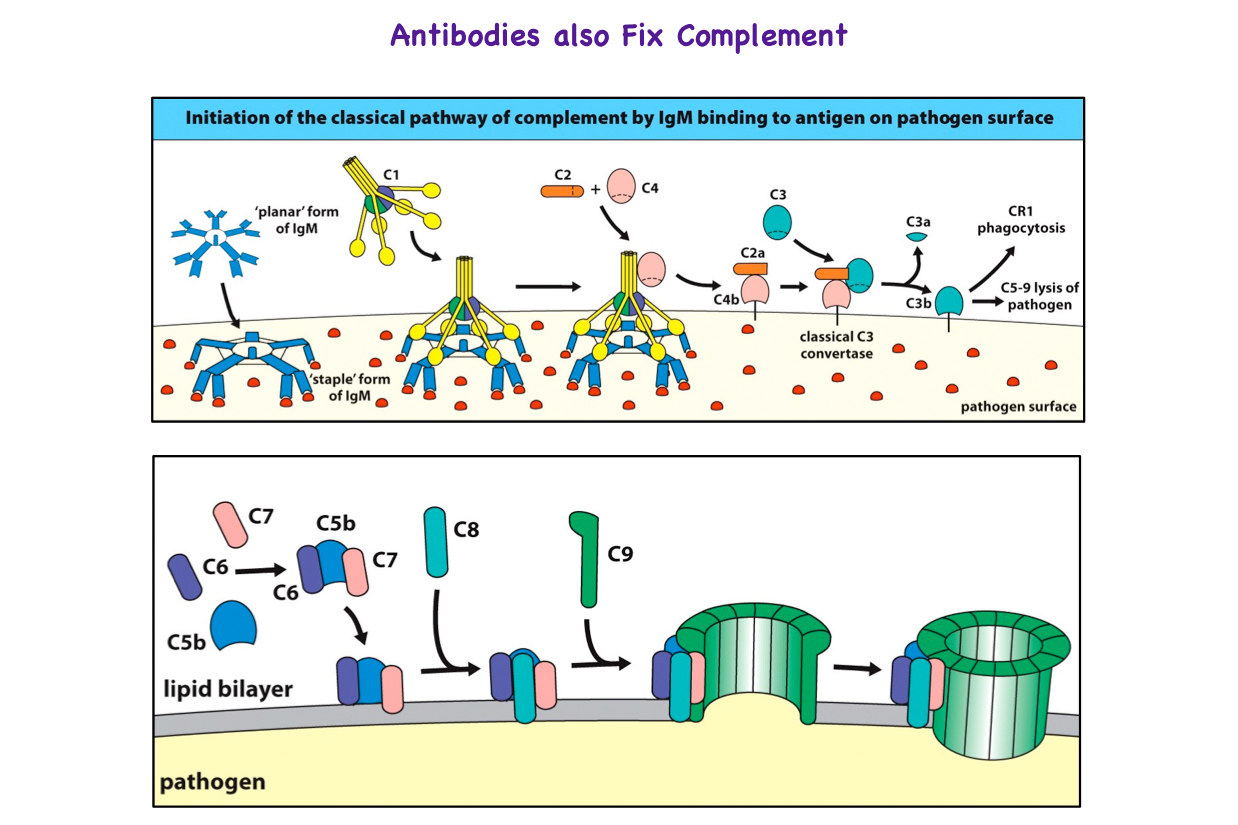
Ocreliziumab is a CD20-killer and it does this by complement fixation to blow holes in the target and uses antibody dependent cellular cytotoxicity to blow holes in the target. 

"Complement fixation" is where the complement binding site on the antibody molecule stimulates the complement cascade starting with C1 and ending with C9.


The complement system consists of a number of small proteins found in the blood, in general synthesized by the liver, and normally circulating as inactive precursors (pro-proteins). When stimulated by one of several triggers, proteases in the system cleave specific proteins to initiate and amplifying cascade of further cleavages. 


The third complement component binds to the cell/pathogen surface and stimulates C5 to split in to CD5a and C5b.


This stimulates the production of the membrane attack complex.(C5b, C6, C7, C8, C9) to form a pore in the surface of the target so that the cell contents explode from the cell.

                      It is just like a pin popping a balloon.

Antibody dependent cellular cytotoxicity.  Antibody binds to the target cell and then a natural killer cell binds to the tail of the antibody (Fragment crystallisable = Fc) via Fc receptors. The natural killer cells release porforins that punch holes in the targets.

We know alot about rituximab and how it depletes, Ocrelizumab is more active than rituximab at complement fixation and ADCC and so it is going to be a more effective killer. 


Ocrelizumab news: finally two eagles have landed

Ocrelizumab news: finally two eagles have landed

Landmark decision by the CHMP; ocrelizumab gets licensed for both relapsing and primary progressive MS.


For all those pwPPMS who have been waiting for a treatment for their disease. Your wait is almost over. After many anxious months, and against the opinion of many naysayers, the CHMP (Committe for Medicinal Products for Human Use) have greenlighted ocrelizumab for the treatment of PPMS in Europe. It is not quite the liberal license of other countries, but it is a start. 

"Ocrevus is indicated for the treatment of adult patients with relapsing forms of multiple sclerosis (RMS) with active disease defined by clinical or imaging features (see section 5.1). 

Ocrevus is indicated for the treatment of adult patients with early primary progressive multiple sclerosis (PPMS) in terms of disease duration and level of disability, and with imaging features characteristic of inflammatory activity (see section 5.1)."

The question I have for Roche is will they take up our #ThinkHand challenge and do a trial in people with more advanced MS, i.e. those who are in wheelchairs? 

I personally would like to thank all the pwMS who participated in both the relapsing (Opera 1 & 2) and primary progressive (Oratorio) trials; without you we wouldn't have gotten here. Progressive MS is now a tractable problem, what we now need is combination therapy trials. 


ProfG