On how patients with multiple sclerosis weigh side effect severity and treatment efficacy when making treatment decisions.
Exp Clin Psychopharmacol. 2017 Dec;25(6):479-484. doi: 10.1037/pha0000152.
Abstract
Although effective disease-modifying treatments (DMTs) are available for individuals suffering from multiple sclerosis (MS), many patients fail to take their recommended medications. Unlike medications that provide immediate relief from existing symptoms, DMTs decrease the probability of future symptoms (i.e., a probabilistic benefit) while concurrently carrying an appreciable risk of immediate side effects (i.e., a probabilistic cost). Prior research has shown that both the probability of reducing disease progression and the probability of experiencing side effects impact patients' likelihood of taking a hypothetical DMT. The role that side effect severity plays in treatment decisions remains unexplored. The present study examined how probability of medication efficacy and side effect severity impact patients' likelihood of taking hypothetical DMTs. Patients' likelihood of taking a DMT systematically decreased as medication efficacy decreased and side effect severity increased. Because side effect severity appears to impact decision-making processes in unique ways, the present results suggest that providers should present information on severe (which are typically rare) and mild to moderate side effects (which are more common) separately.

Trust is a state of mind, built and sustained by small actions over many encounters, and once you have it solid as the Rock of Gibraltar. This is why the doctor-patient relationship is trickier than your usual run of the mill social encounter. The stakes are also high; future health vs potential harm. In what is essentially an encounter littered with emotive undertones (particularly when it comes to treatment decisions), can you steer decision making process to the mutual satisfaction of both parties?
In this publication, Jarmolowicz et al. found that the likelihood of uptake of treatment in MS reduced as the likelihood of benefiting from the treatment reduced (no surprise there; see Figure 1 below). They also found that there was consistent effect from side effect severity in decision making processes, such that likelihood of risking severe side effects is significantly less than the likelihood of risking moderate and mild side effects. Also called the 'prospect theory' in economics, where there is essentially an over-valuation of losses over gains (see Figure 2 below).
 Figure 1: Left graph shows the probabilities of taking medications (y-axis) at each odds against treatment success (x-axis) on questions with mild (open circles), moderate (gray circles), or severe (closed circles). The top right graph shows delay discounting rates (LN[k]) for each side effect severity (different color bars), with error bars showing the 95% confidence interval. The bottom right graph shows the value of A (i.e., fitted parameter showing likelihood of taking medications when they are 100% effective) for each side effect severity (different color bars), with error bars showing the 95% confidence interval. Asterisk indicates statistically significant (p < 0.001) comparisons.
The authors therefore advice that clinicians separate out the discussions on severe vs mild to moderate treatment-related side effects, and to perform a comprehensive assessment of patient motivation and decision making at the beginning.
The question is whether being aware of the pitfalls in health encounters make us better clinicians, or better patients at the end of the day?
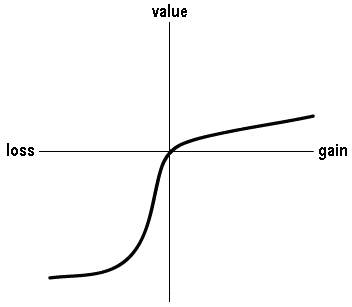 Figure 2: Prospect theory - the value function is steeper for losses than gains indicating that losses outweigh gains.
Exp Clin Psychopharmacol. 2017 Dec;25(6):479-484. doi: 10.1037/pha0000152.
On how patients with multiple sclerosis weigh side effect severity and treatment efficacy when making treatment decisions.
Jarmolowicz DP, Bruce AS, Glusman M, Lim SL, Lynch S, Thelen J, Catley D, Zieber N, Reed DD, Bruce JM.Abstract
Although effective disease-modifying treatments (DMTs) are available for individuals suffering from multiple sclerosis (MS), many patients fail to take their recommended medications. Unlike medications that provide immediate relief from existing symptoms, DMTs decrease the probability of future symptoms (i.e., a probabilistic benefit) while concurrently carrying an appreciable risk of immediate side effects (i.e., a probabilistic cost). Prior research has shown that both the probability of reducing disease progression and the probability of experiencing side effects impact patients' likelihood of taking a hypothetical DMT. The role that side effect severity plays in treatment decisions remains unexplored. The present study examined how probability of medication efficacy and side effect severity impact patients' likelihood of taking hypothetical DMTs. Patients' likelihood of taking a DMT systematically decreased as medication efficacy decreased and side effect severity increased. Because side effect severity appears to impact decision-making processes in unique ways, the present results suggest that providers should present information on severe (which are typically rare) and mild to moderate side effects (which are more common) separately.

Trust is a state of mind, built and sustained by small actions over many encounters, and once you have it solid as the Rock of Gibraltar. This is why the doctor-patient relationship is trickier than your usual run of the mill social encounter. The stakes are also high; future health vs potential harm. In what is essentially an encounter littered with emotive undertones (particularly when it comes to treatment decisions), can you steer decision making process to the mutual satisfaction of both parties?
In this publication, Jarmolowicz et al. found that the likelihood of uptake of treatment in MS reduced as the likelihood of benefiting from the treatment reduced (no surprise there; see Figure 1 below). They also found that there was consistent effect from side effect severity in decision making processes, such that likelihood of risking severe side effects is significantly less than the likelihood of risking moderate and mild side effects. Also called the 'prospect theory' in economics, where there is essentially an over-valuation of losses over gains (see Figure 2 below).
The authors therefore advice that clinicians separate out the discussions on severe vs mild to moderate treatment-related side effects, and to perform a comprehensive assessment of patient motivation and decision making at the beginning.
The question is whether being aware of the pitfalls in health encounters make us better clinicians, or better patients at the end of the day?